Flaminal® Hydro/Forte
Flaminal®
Hydro/Forte
Our solution for acute and chronic wounds
Flaminal® can be used for acute and chronic wound types, or wounds at risk of infection: Flaminal® Hydro for slightly to moderately exuding wounds and Flaminal® Forte for wounds with moderate to high amounts of wound exudate.
What is Flaminal®?
Debriding Gel
dissolves necrotic tissue and fibrinous slough and absorbs them from the wound bed
Absorbent alginale
absorbs excess exudate, enables autolytic debridement (cleaning of wound and absorption of bacteria)
Antimicrobial enzyme system
offers antimicrobial protection and reduces bacteria released from a biofilm
How it works
Comprehensive care for exuding wounds
Flaminal® supports the natural healing of acute and chronic wounds. With its unique formulation, Flaminal® offers versatile wound management, provides continuous debridement, keeps the wound moist and offers antimicrobial protection to speed up healing process.
Benefits of Flaminal®
-
Why use Flaminal®?
- Versatile: suitable for various wound types.
- Safe: Flaminal® is non-toxic to healthy skin cells and wound tissue.
- Effective: addresses all aspects of TIMES wound assessment.
- Antimicrobial Protection: a unique mode of action.
- Can be used in all age groups
- Easy to Apply: suitable for any wound shape and size.
- Sustainable: no primary dressing to dispose of and no need for multiple products.
-
What makes the difference?
- Flaminal® combines an absorbent alginate with an antimicrobial enzyme system. 1,3
- The antimicrobial action of Flaminal® only takes place in the gel matrix, not on the wound bed. The enzyme system “kills” the bacteria that are absorbed in the gel matrix. 1
- Flaminal® ensures optimal wound conditions and supports wound healing right from the start. 2
How to apply
Step 1
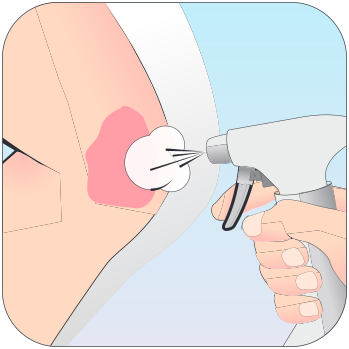
Clean the wound following local protocols.
Choose which Flaminal® to start with according to exudate levels.
Use Flaminal® Hydro on slightly to moderately exuding wounds, Flaminal® Forte on moderately to highly exuding wounds.
Step 2
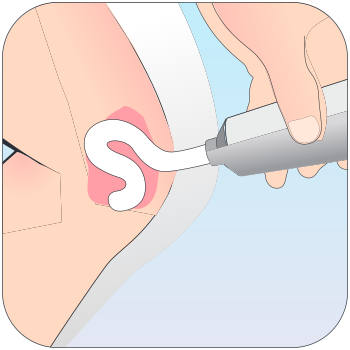
Apply Flaminal® covering the entire wound bed with a sufficiently thick layer (e.g. 4-5mm).

Step 3
Cover Flaminal® with the appropriate secondary dressing according to exudate levels.
Check the dressing daily.
The dressing with Flaminal® can remain in place as long as the gel structure is intact (1 to 4 days, depending on the amount of exudate).
Where to use
Flaminal® can be used for a variety of wound types.
Discover our products
Flaminal® 2 formulations and different sizes
Flaminal® is available in 2 formulations Flaminal® Hydro and Flaminal® Forte and in different sizes to adjust to patient needs.
Flaminal® Hydro
Lower Alginate Content
For slightly to moderately exuding wounds
| Size |
|---|
10x10g |
25g |
40g |
Flaminal® Forte
Higher Alginate Content
For moderately to highly exuding wounds
| Size |
|---|
10x10g |
25g |
40g |
FAQ
Flaminal® Hydro is indicated for slightly to moderately exuding wounds, while Flaminal® Forte is indicated for moderately to highly exuding wounds. (Exuding wounds are oozing/ leaking wounds). Examples of such wounds are:
- leg ulcers
- diabetic foot ulcers
- superficial and deep partial thickness burns (second degree)
- post-surgical wounds
- traumatic wounds
- pressure ulcers (pressure sores)
- skin tears
- wounds from radiotherapy
- oncology wounds By debriding the wound, Flaminal® (Hydro and Forte) are also indicated to prepare the wound for subsequent surgery such as skin grafting or negative pressure wound therapy (wound bed preparation.)
Yes. We would advise you to apply Flaminal® Hydro.
Flaminal® Hydro and Flaminal® Forte keep the wound moist Flaminal® Hydro and Flaminal® Forte keep the wound clean/debride the wound continuously. Flaminal® Hydro and Flaminal® Forte offer antimicrobial protection. Flaminal® Hydro and Flaminal® Forte is safe for the skin and wound tissue. Flaminal® Hydro and Flaminal® Forte protects the wound border.
Step 1: Flaminal® (Hydro & Forte) absorb exudate pus and bacteria into its structure.
Step 2: The enzyme system consists of two enzymes, glucose oxidase and lactoperoxidase. The first enzyme, glucose oxidase forms a peroxide. The second enzyme, lactoperoxidase immediately captures the peroxide and transforms it into oxygen radicals (ROS, Reactive Oxygen Species). These radicals destroy the bacterial cell wall. Flaminal® (Hydro & Forte) has been tested in vitro against a wide range of clinically isolated bacteria (such as MRSA, E. coli, E. aerogenes, P. aeruginosa,…). This is a selective process. Only bacteria are destroyed and not human cells, such as keratinocytes and fibroblasts.
Systemic antibiotics can be used complementary when Flaminal is applied on your wound. When a wound is infected, antibiotics may be indicated. Infection is caused by bacteria infiltrating the deeper tissue layers of the wound. These bacteria are not adequately inhibited or destroyed by your immune system, nor by a topically applied antimicrobial product. However, some chronic wounds have poor blood flow and only small amounts of antibiotics may reach the wound. Ask your doctor or wound clinician for advice.
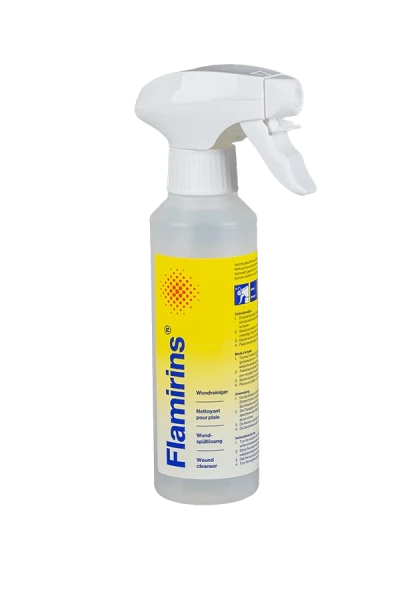
Clean the wound with a cleanser such as Flamirins®. Apply Flaminal® Hydro (in the case of moderate exudate) or Forte (when there is severe exudation) To dissolve and absorb (remove) fibrin, as the ongoing presence of fibrin slows down wound healing and complicates the diagnosis. To protect the wound from infection with the antimicrobial enzyme system present in Flaminal® (Hydro & Forte) To maintain a moist and clean wound. To protect the wound borders. Apply a dressing to cover Flaminal® Hydro or Flaminal® Forte. The choice of dressing will depend on the amount of exudate from the wound. Inspect the wound daily and change the dressing each day or every two days.
Yes. Flaminal® (Hydro & Forte) can be stored in the refrigerator. In fact, if the room temperature where the Flaminal® (Hydro & Forte) is stored is likely to exceed 25°C, it is preferable to keep Flaminal® (Hydro & Forte) in the refrigerator. Flaminal® (Hydro & Forte) should not be stored in the freezer.
The type of secondary dressing will depend on the wound condition. On a wetter wound a more absorbent secondary dressing should be used to prevent maceration, e.g. Foam dressing or superabsorbent. On drier wounds a secondary dressing should be selected which will reduce evaporation and prevent the wound drying out, e.g. Film or Hydrocolloid.
Yes. Diabetes patients can use Flaminal® (Hydro & Forte) on wounds.
Flaminal® Hydro contains 3,5 % alginate which would be well suited; it will aid debridement of slough and thereby promote wound healing.
Our products
We believe in the unique benefit of a biotechnological approach, preserving what is good in the wound and eliminating what is bad, thus providing the ideal environment for a wound to heal.
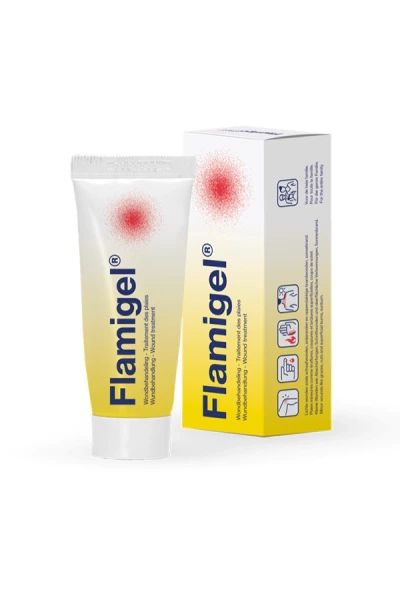
Sources
- De Smet, K. et al. Pre-clinical evaluation of a new antimicrobial enzyme for the control of wound bioburden. Wounds. 2009, 21(3): 65 - 73.
- Jones, J. et al. TIME to assess wounds - a clinical evaluation of FLAMINAL® (ZEIT für die Bewertung von Wunden - eine klinische Evaluierung von FLAMINAL®) Wounds UK. 2018, 14(3): 63 - 69.
- White, R, Linssen, E: Wundbettvorbereitung, T.I.M.E. und ein Enzym-Alginogel: Literaturübersicht und die klinische Praxis. Wund Management 2016, 10(2), 87 - 90.